Updated Nov 6, 2026
Old radio voice generator
Old Radio Voice Generator
This old radio voice generator puts your script on the air around 1950: a commanding announcer, a narrow band with no chest and no sparkle, and a soft hiss under every pause. Type a newscast, a sponsor read or a drama’s opening narration and keep Overlord. Analog at 45% is light enough for a period drama, and one step from a broadcast that shouldn’t exist.
Ready
Overlord · Analog
3 of 3 free today · no sign-up needed
Script ideas
Old radio scripts to read on air
Golden-age radio was written for the ear: full sentences, formal greetings and sponsors thanked by name. The first four scripts are period pieces; the last two are broadcasts that shouldn’t exist. Every station, town and sponsor is invented, and every script loads into the old radio voice generator with one click.
“Good evening, ladies and gentlemen. The county council has approved the new river bridge, the harvest fair opens Saturday, and the weather bureau promises clear skies. And now, the late news.”
At 30% the band opens up: a clean period newscast.
“Friends, are cold nights keeping your family awake? Linden Hill Cocoa is the warm cup that sends the whole house off to sleep. Ask your grocer for the green tin.”
Matron makes a warm studio hostess for the commercial break.
“Tonight, the Wren Street Players present a story of a hotel, a snowstorm and a guest who signed the register twice. Turn down your lamps, draw closer to the set, and listen.”
Leave a full beat after “listen” for your music sting.
“You’re listening to The Late Hour. Stay right where you are: after a word from our sponsor, we return with tonight’s mystery.”
Generate it once and reuse it every episode; the setting never drifts.
“Good evening. Here is tomorrow’s news. A fire at the picture house on Third Street claimed no lives, thanks to the listeners who heard this bulletin a day early and stayed home. Please, stay home.”
Push Analog to 70% for a signal that is barely holding.
“This concludes our broadcast day. Thank you for listening, and please switch off your set before you sleep. A radio left playing after sign-off has been known to pick up something listening back.”
Broadcast reads it flatter, like an old transcription disc.
Effect recipe
How the tube-radio sound is built
An old radio voice is mostly what is missing: the chest, the air, the room. This page runs Analog at 45%, live in your browser through the Web Audio API:
Overlord
- 1
Cabinet speaker
~500 Hz – 3.06 kHzA high-pass and a low-pass keep only the middle of the voice, what a small speaker in a wooden cabinet could play. Overlord loses his chest but keeps every consonant.
- 2
Warm valves
waveshaper drive 47Moderate saturation rounds off the peaks, like an amplifier running warm rather than a chewed-up tape.
- 3
One mic, one county
compressor −24 dB, 8:1Every syllable arrives at the same level: the projected, even delivery of one voice reaching a whole region.
- 4
Set noise
band-passed noise at 2.5 kHz, gain ~0.026A faint hiss fills the pauses, so even the silence between sentences sounds like radio.
- 5
Slightly slow
0.973×, about −0.5 semitonesAbout 2.7% slower and a touch lower: a 30-second sponsor read lasts about 30.8 seconds, plus a 1.2-second tail. Time your bumpers to that.
How it works
How to make an old radio voice in three steps
- 1
Write it for the ear
“Good evening, ladies and gentlemen.” Full sentences, the sponsor by name, frequencies as words.
- 2
Pick the announcer
Overlord for the commanding newsreader, Broadcast for a flatter transcription, Matron for the studio hostess. Preview each one as an old radio voice through Analog for free.
- 3
Set the band and export
Start at 45%. Go lower for a cleaner period sound, higher for a failing signal, then download the WAV to keep the radio baked in.
Use cases
Where a golden-age announcer fits
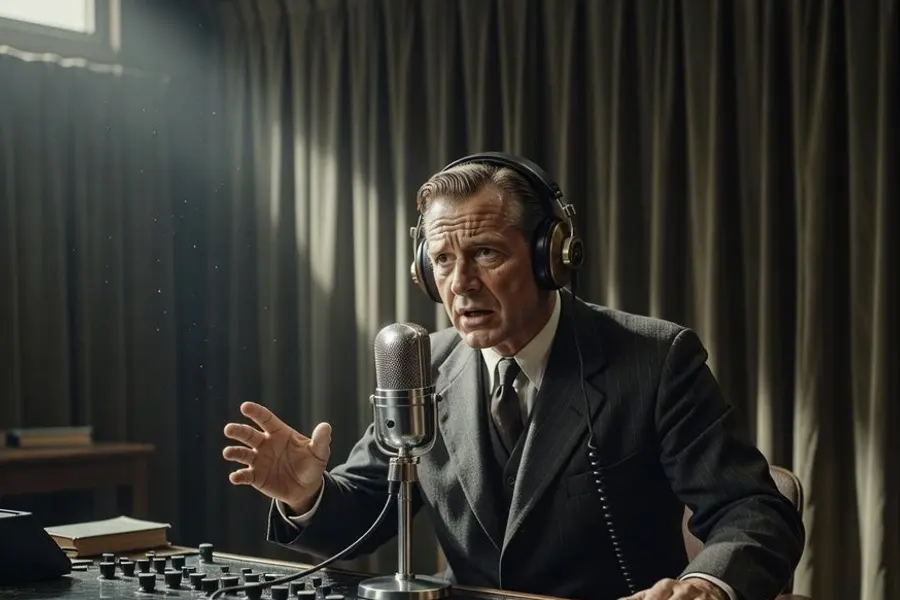
Old-time radio drama and audio theater
Opening narration, act breaks and a sponsor read between scenes; generate the announcer once and cast your actors around him.
Period films and games
A 1940s–50s newscast from the set on the kitchen table, the car radio on a night drive, the wireless in a game’s roadside diner. Export each bulletin as its own WAV.
Podcast intros and segment bumpers
A ten-second intro, a “we’ll be right back” and a sign-off. Same old radio voice, same setting, every episode.
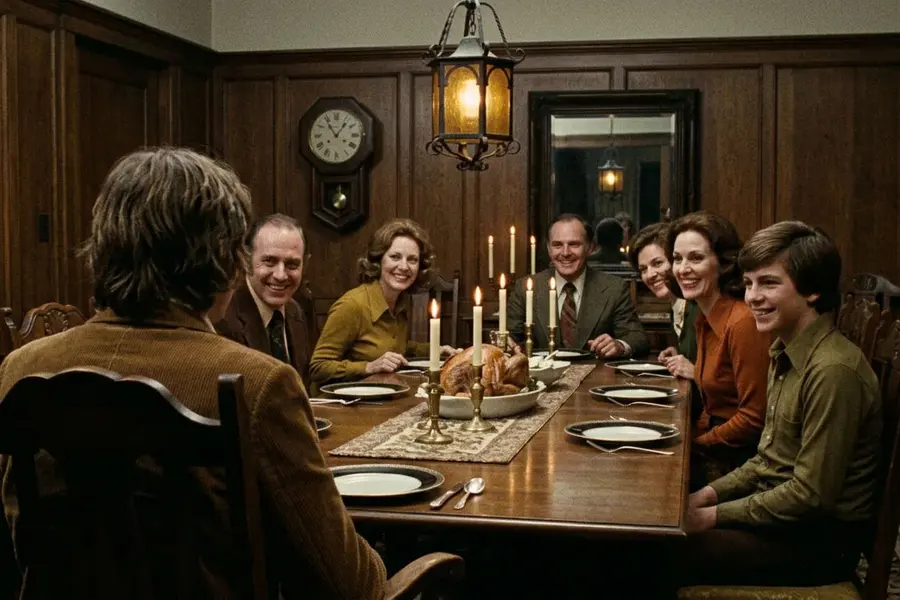
Found footage and analog horror cutaways
The broadcast that shouldn’t exist: tomorrow’s news, a station that went off the air decades ago, a sign-off that keeps talking. Raise the intensity when the signal goes wrong.
Tips
Tips for a convincing old radio voice
- Write formally, as if to a whole county: complete sentences, titles, “ladies and gentlemen”. Casual phrasing breaks the period faster than any sound.
- Spell out numbers and frequencies — “eleven-forty on your dial”, “nineteen fifty-one” — so the voice reads them at an announcer’s pace.
- Invent the station, the town and the sponsor. Don’t borrow a real announcer’s name, a real show, or call letters that may belong to a real station.
- If the piece looks like a documentary, label the broadcast as a recreation so nobody takes it for an archive recording.
FAQ
Old radio voice generator FAQ
Old radio voice generator: type a newscast, a sponsor read or a drama opening, and hear a commanding announcer through a narrow tube-radio band with hiss. Free.
Keep exploring
More scary voices
Put it on the air
Write the announcement, keep Overlord on Analog at 45%, and hear it from a set nobody has built in decades.