Knowing how to tell a scary story is mostly knowing what to leave out. The listener’s imagination does the frightening. Your job is to give it a normal world, one thing wrong with that world, and enough silence to fill. That holds for a ghost story at a sleepover, a horror story for a podcast, or the campfire tale you tell every summer.
Pick a scary story for the people in front of you
Young children. Scholastic’s tips from storyteller Donna Washington suggest letting children 8 and under see the scary thing coming, avoiding big surprises, making the climax silly or funny, and ending so the scary thing is clearly gone. A lonely ghost who only wanted a friend is plenty.
Older kids. For roughly third to fifth grade, the same tips allow a quick jump: a brief fright, not a week of bad dreams, and still a safe ending.
Teens and adults. Trade surprise for dread: a story told as true, set somewhere everyone knows, with an ending that doesn’t resolve.
Mixed groups. Aim at the youngest or most anxious listener. Ask before you start and let anyone step out; a scary story works because people chose to be scared.
Know which kind of scary story you have, because how to tell a ghost story differs from how to tell a horror story. A ghost story is about a presence, often grief or a place; a horror story, a threat to the body; a campfire story is local and told as true.
Structure: hook, build, turn, final beat
A scary story that works out loud usually has four parts. An original example, one part at a time:
The hook sets an ordinary world with one strange fact in it.
Every winter somebody sees a woman standing out on Miller Lake, and every winter the ice is too thin to hold a dog.
The build adds concrete, everyday details and narrows to one person.
My uncle drove the night plow that year. He said she was right in the middle of the lake, facing the road, facing his headlights. He said the snow wasn’t landing on her.
The turn is the sentence where the floor gives way. One sentence, said plainly.
He looked down to change gear, and when he looked up she was gone, and there were wet footprints coming off the ice, up the bank, to his passenger door.
The final beat is shorter than anything before it and leaves the danger open.
He drove home with the heater on full. The passenger window fogged up the whole way.
Then stop. No explanation, no moral. In a University of Alberta piece, ghost-story author Barbara Smith advises against over-explaining and suggests letting the silence hang once you finish (how to tell a terrifying tale). Explain a scary story and you have solved it, and a solved mystery frightens no one.
Delivery: pace, pauses, volume and eyes
- Start at normal speed. Sound spooky from the first word of a scary story and there is nowhere left to go.
- Slow down on the way to the turn, each sentence a little slower than the last.
- Pause before the key words, not after. In the example, the gap goes just before “to his passenger door”.
- Drop your volume. People lean in to hear a quiet teller. Louder works once; quieter works all night.
- Use eye contact during the build, one listener per sentence. At the turn, look past them into the dark.
- Say the turn flat. Acting it out tells the audience how to feel.
- Use the jump ending sparingly. A sudden shout on the last word gets a scream, then a laugh, and spends the mood. Save it for a group that knows the game; never use it on young children or anyone anxious.
Set the scene
- Light. One low source. Outdoors, let the fire burn down as you talk. Indoors, sit by a single lamp and switch it off just before the final beat. Scholastic’s tips suggest flashlights for older kids and dimmed lights for younger ones.
- Sound. A quiet bed of wind or rain under a scary story makes the silence louder when you stop. The studio’s Sound effects tab can make a seamless loop from a short description.
- Seating. Listeners close together, the teller with their back to the dark.
- Make it local. A scary story set in “the house past the gas station” lands harder than one set in “a house”.
Read a scary story aloud or memorize it?
Either works if you rehearse: Barbara Smith’s advice is to know a story well even when you read it, and to rehearse it several times.
- Memorize the shape, not the words. Know the four parts of the scary story and the exact final line; tell the rest in your own words.
- Reading is fine for bedtime and classrooms. Mark pauses on the page with a slash, and look up for the turn and the final beat.
- Rehearse out loud. Silent reading hides the sentences too long for one breath.
Record a narrated version
A recorded scary story suits a short video, a podcast or a classroom.
- Split the scary story at the parts, one clip each. Free use allows 3 generations a day of up to 300 characters each, with no sign-up; signed in, credits cover up to 2,000 characters a clip.
- Choose the teller. Whisperer sounds like a frightened narrator who shouldn’t be telling you this. Matron is a bedtime voice that is calm in the wrong way.
- Add a light effect. Echo at around 30% puts the teller in a cellar, with repeats about 0.3 seconds apart that darken each time. Ghost at around 30% moves the voice a room away without blurring words.
- Shape the final beat. Signed in, the Cinematic engine reads tags such as
[whispers]; put one before the last line. - Export and join. Download each clip as a WAV with the effect baked in, join them in an editor, and leave real silence before the final beat.
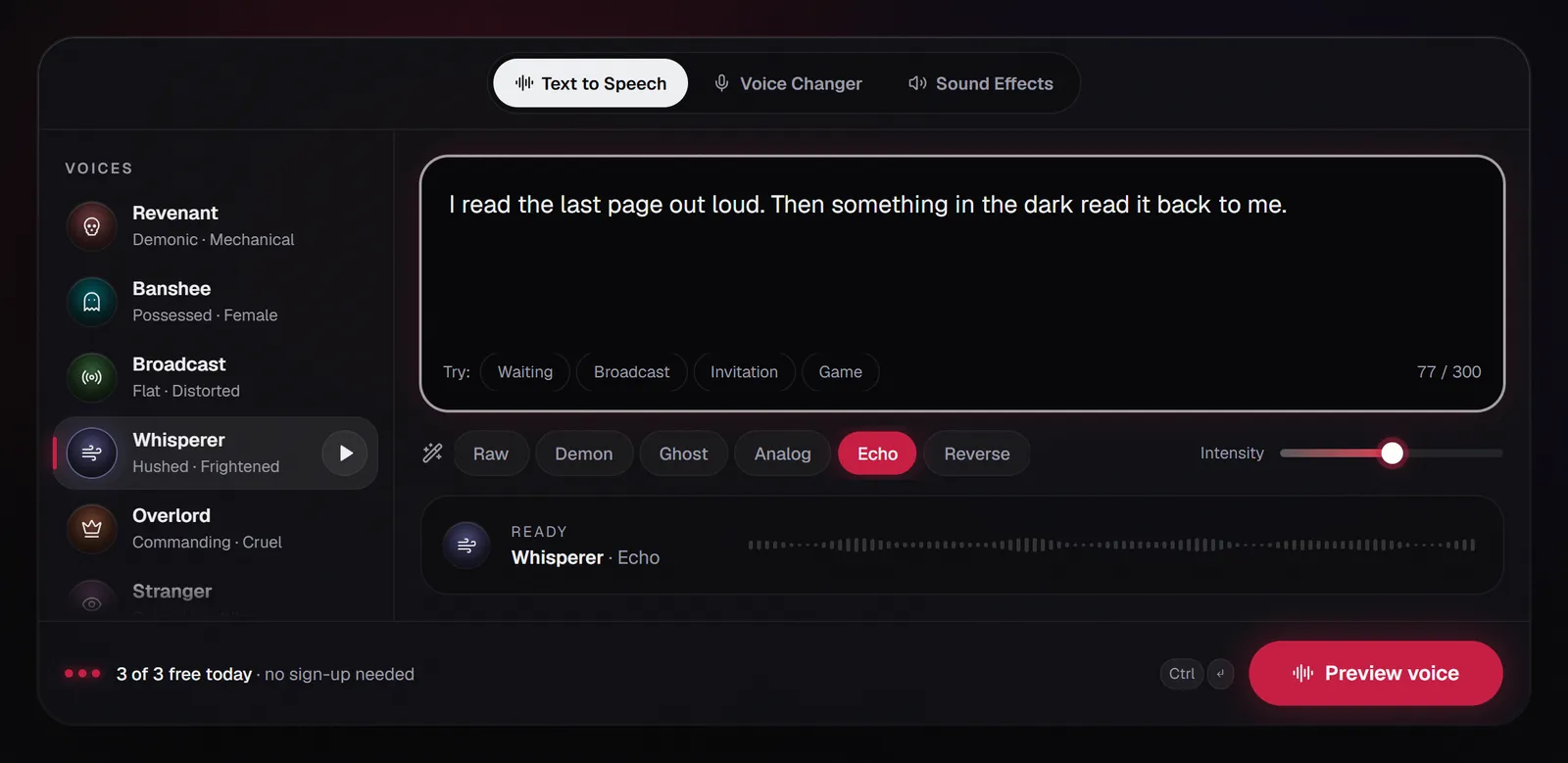
Whisperer, from dry to cellar
Prefer your own voice? Record yourself telling the scary story in the Voice changer tab, add Echo and download the WAV. For long first-person internet horror, the creepypasta voice generator is set up for that style of read. For the voice itself, see how to make a scary voice; for found-footage formats, how to make analog horror.
Exercise: the two-sentence story
The quickest way to practise how to tell a scary story is the two-sentence horror story. Sentence one is hook and build: a normal world. Sentence two is the turn and final beat in one.
The new house came with a key for every door. Tonight I found the door the last key was for, at the back of the closet, locked from the other side.
My daughter waves at her window every night before bed. Her room is on the third floor, and tonight something waved back.
Write three of your own:
- No fear words. “Terrifying” and “creepy” tell the listener what to feel.
- Put the word that turns the scary story as close to the end as you can.
- Read it aloud with a full pause between the sentences.
- Record each sentence as its own clip, so the pause is yours to set.
The two-sentence horror stories page has more original ones to load into the studio and hear read aloud.
FAQ
What makes a scary story scary?
A normal world, one wrong detail and a gap the listener has to fill. Ordinary details such as a snowplow or a fogged window make the world believable; leaving the threat unexplained makes it stick. A scary story that describes its monster in full leaves the listener nothing to imagine.
How do you start a scary story?
With an ordinary place and one strange fact, in a sentence or two. Telling the scary story as something that happened nearby, to someone you know, pulls listeners in faster than “once upon a time”.
How do you end a scary story?
Right after the turn, with one short beat that leaves the danger open, then silence. For young children, do the opposite: the scary thing is gone and everyone is safe.
How do you tell a scary story to kids?
Choose a gentle scary story with a funny or kind ending, let them see the scary part coming, keep the room dim rather than dark, and skip jump endings for the youngest.
How do you tell a scary story around a campfire?
Make it local, tell it as true, let the fire burn low and slow down toward the turn. Then leave a long silence after the last line.
How do you narrate a horror story for a video or podcast?
Split the scary story into clips at the four parts, keep the narrator calm, add a light Echo or Ghost effect, and join the WAVs with real pauses.