Horror sound design is the part of a scary scene the audience notices least and feels most. A picture can show a hallway; the sound decides whether something is in it. This guide treats horror movie sound design and horror game sound design together, because the building blocks are the same; games add looping, randomization and distance.
Map the scene before you build
Good horror sound design starts on paper. Watch the scene with the sound off, or walk the level layout, and write one line per beat: what the audience should hear, what they should not, and where the silence falls.
- Name the place. One phrase for the room tone, such as a cold basement with a boiler ticking.
- Mark the turn. The moment the threat arrives; everything before it builds toward a gap.
- Give the threat one signature sound, and keep that sound out of everything else.
- Note what stops. The layer you pull out before the scare matters as much as the hit.
A sound map like this keeps horror sound design consistent across a scene, and tells you which layers to generate before you open an editor.
Silence and dynamics
Fear needs a quiet baseline: if everything is loud, nothing is.
- Silence is never digital zero. A cut to absolute nothing sounds like a fault. Scary "silence" is room tone: the faint air of the space with every other layer pulled out.
- Subtract before the event. Pull the music, then the wind, then the clock, until only room tone is left. The audience notices that something has stopped, and leans in.
- Wait longer than feels safe. A pause that should end in a scare, and doesn't, makes the next pause worse.
- Keep the range wide. In horror sound design, the gap between the quietest and loudest moment makes a hit land; squash everything and the scare flattens.
Low-frequency drones
A drone, the backbone of most horror sound design, is a sustained low tone or noise that never resolves: a ventilation hum, a slowed-down cello note, a distant rumble.
You will often read that horror films use infrasound, sound below the roughly 20 Hz floor of human hearing. The evidence is thinner than the claim. In a 2026 study in Frontiers in Behavioral Neuroscience, 36 participants listened to music while hidden subwoofers played an 18 Hz tone in half the sessions. Those exposed had higher salivary cortisol, reported more irritability and rated the music sadder, yet could not reliably tell when the infrasound was on (MacEwan University release). The authors note the small sample and the single frequency tested.
In practical horror sound design the question is mostly moot: phone speakers and most earbuds can't reproduce very deep bass anyway. Give the drone audible movement in the low mids, slow swells and a texture on top, such as a faint metallic rattle.
Dissonance, roughness and nonlinear sounds
- Roughness. A team led by Luc Arnal found that screams occupy a narrow acoustic niche: amplitude or frequency changing 30 to 150 times a second, heard as roughness, against around 4 to 5 for normal speech. Alarms and dissonant intervals fell in the same range, and both raised activity in the amygdala (Current Biology study release).
- Nonlinear sounds. Many animals' calls turn noisy and chaotic under duress. A 2010 analysis of film soundtracks in Biology Letters found horror clips had more noisy screams and non-musical sidebands than expected (Blumstein, Davitian and Kaye).
In horror sound design, that translates into a few moves: detune two layers until they beat against each other, scrape metal, overdrive a texture until it breaks up, and let a pitch slide where the ear expects it to hold.
The stinger
A stinger is the short, loud hit on a scare, and the most overused tool in horror sound design. It has three parts:
- The lead-in. Silence, or a rise the audience can feel coming. Taking the bed out a beat early is the cheapest lead-in there is.
- The hit. A sharp transient, a low thump for weight and a harsh high layer, all starting on the frame of the cut.
- The tail. A fast, dark decay, so the next moment begins in quiet.
A useful trick: generate a hit in the studio and play it through Reverse. At 60%, the clip runs backwards into a 3.5-second hall at a wet level of 0.56, at 0.928× speed, so the decay becomes a swell rising into the cut. Put it just before the untouched hit. For ready-made hits, see the jumpscare sound effect page.
Spend stingers rarely: an audience that has been hit a few times starts bracing, and a braced audience doesn't jump.
Diegetic and non-diegetic sound
Diegetic sound comes from inside the story: footsteps, a radio, a door. Non-diegetic sound, such as the score, exists only for the audience. Horror sound design plays with the border: a knock from the next room whose source we never see, a music-box theme from the score that starts playing from a toy on the shelf.
Ambience beds and loops
An ambience bed is the sound of the place itself, and the part of horror sound design the audience notices only when it stops. Build it in layers:
- Layer
- Room tone
- What it does
- Defines the space; the “silence” you cut to
- A description for the Sound effects tab
- Empty farmhouse kitchen at night, faint fridge hum, still air, no music
- Layer
- The constant
- What it does
- A steady element you can take away later
- A description for the Sound effects tab
- Light rain on a tin roof, even and steady, no thunder
- Layer
- Sparse details
- What it does
- Small events that keep the place alive
- A description for the Sound effects tab
- One slow wooden creak somewhere upstairs, far away, dry
In AI Scary Voice, open the Sound effects tab, describe one layer in up to 300 characters, and switch on Seamless loop for beds. Each generation gives up to two takes and shares the 3 free generations every visitor gets each day.
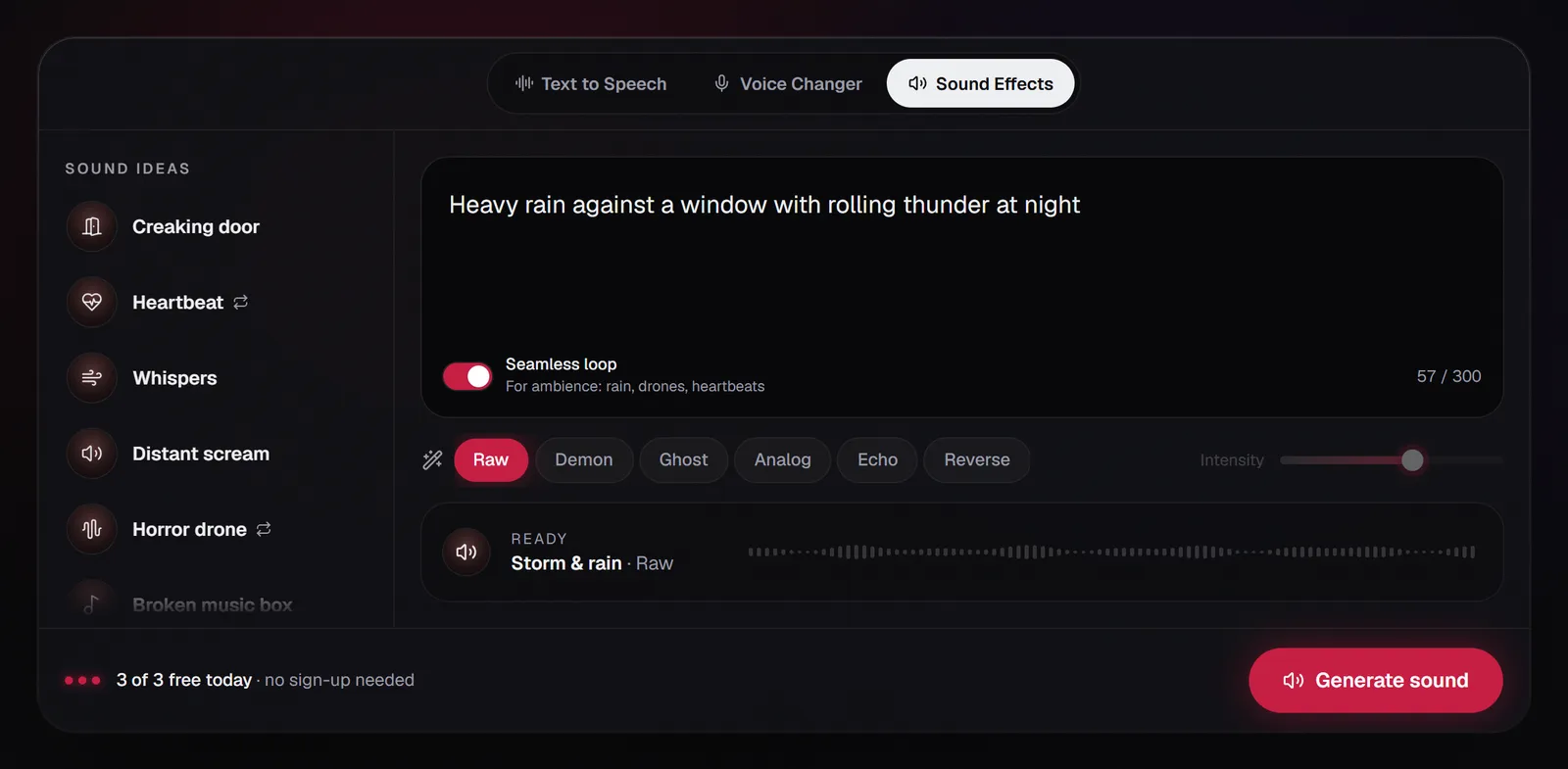
Keep loops even and generate details as separate one-shots; a loud event inside a loop is obvious the second time round. For a clean loop, download the raw MP3: every effect except Raw slows the clip slightly and adds a reverb tail to the WAV, which breaks the seam. The horror ambience generator opens ready for beds like these.
Voices processed as sound design
In horror sound design, a voice pushed far enough becomes a texture the ear still half-recognizes as human, which is exactly what unsettles.
- Backwards whispers. Reverse at 0% only flips the clip, with no reverb and no slowdown. At 80% a hall appears at a wet level of 0.63 and the clip plays at 0.904×.
- A voice with no body. Ghost at 100% high-passes at 580 Hz, drops the dry voice to 0.30 against a 4.5-second reverb at 0.95, and adds a detuned double: a presence, not a speaker.
- A voice in the walls. Echo at 80% repeats every 0.372 seconds with feedback at 0.5, each repeat darker than the last.
One whisper, four textures
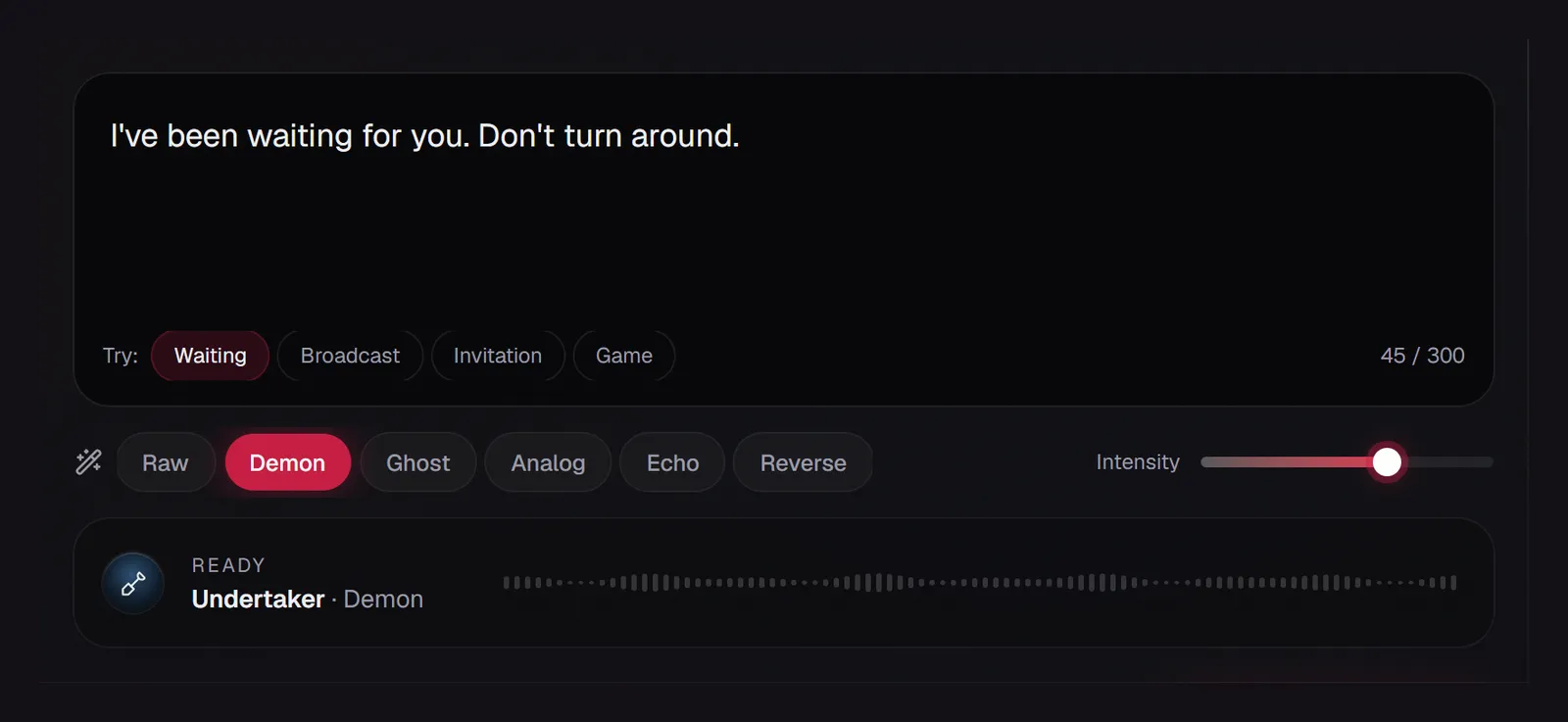
Tuck the WAV low under the bed, where it reads as part of the horror sound design rather than as a line of dialogue. For creature vocals built from layers, see how to make a monster voice.
Mixing for fear
Most horror sound design succeeds or fails in the mix, not in the source sounds.
- Decide what the audience hears first in each scene, and turn the rest down until that is true.
- Keep headroom. A low bed lets a stinger be far louder without clipping.
- Check on a phone. If the scare vanishes on a small speaker, add mid-range texture, not more bass.
- Listen once at low volume. Horror is often watched late at night with the volume down, and good horror sound design survives that. If the dread vanishes, lift the bed and the room tone rather than the hits.
Horror game sound design
Horror sound design for games uses the same pieces, but they play for as long as the player stands there, in an order you don't control.
Looping. Beds must repeat without a seam: trim at zero crossings or crossfade the ends, and keep memorable events out. Use the raw MP3 for anything the engine repeats.
Randomization. A sound that plays identically every time stops being scary. Wwise's Random Container offers Shuffle, which avoids repeats until every variation has played, and Limit Repetition, which holds back the last few played (Audiokinetic docs). FMOD's scatterer instrument spawns sounds from a playlist at random intervals and distances, with randomized volume and pitch, and its manual names ambience as the use (FMOD docs).
Distance. In Unity, an Audio Source stays at full volume inside its Min Distance and fades beyond it. Logarithmic rolloff drops fast at first and is more physically accurate; linear rolloff makes far sounds seem more present and harder to place (Unity docs). A creature heard faintly from everywhere is worse than one you can point at.
States. Build the bed in layers the game can add or remove, such as calm, alert and chase. Then take everything out a moment before the encounter: the silence trick, the oldest move in horror sound design, triggered by the player.
To put all of this to work in a short film, see how to make a scary video.
FAQ
What makes a sound scary?
Contrast and uncertainty: a sound that arrives after silence, a source you can't see, or a rough, dissonant texture close to a scream or an alarm. Context does the rest; the same creak is harmless in a comedy, which is why horror sound design always starts from the scene.
What is a stinger in horror?
A short, loud hit on a scare or a cut: a sharp attack, a low thump and a harsh high layer, then a quick decay. It only works after quiet, so good horror sound design uses few.
Do horror movies use infrasound?
That is rarely verifiable, and most home speakers can't play it. A small 2026 lab study linked an 18 Hz tone to higher cortisol and irritability, but in everyday horror sound design, audible low drones do the practical work.
How do you make ambience for a horror game?
Combine a seamless room-tone loop, one steady element and separate one-shot details, and let the engine scatter the details at random intervals and distances. Keep loud events out of the loop: in horror sound design for games, a bed that gives away its own pattern stops being frightening.